Ant colonies in the semi-arid climate of Lubbock thrive along subterranean moisture channels, foundational plumbing penetrations, and irrigated turf borders. In established neighborhoods like Tech Terrace, Melonie…
Ant colonies in the semi-arid climate of Lubbock thrive along subterranean moisture channels, foundational plumbing penetrations, and irrigated turf borders. In established neighborhoods like Tech Terrace, Melonie Park, and Rush, mature root systems and older pier-and-beam foundations create hidden crawlspace voids where odorous house ants and carpenter ants establish secondary satellite nests. In master-planned developments such as Vintage Township and Lakeridge, expansive clay soils shrink during dry spells, pulling away from concrete slab footings and opening direct highway routes into kitchens and bathrooms. Standard store-bought contact pyrethroids trigger an immediate survival response known as budding, causing a single queen colony to fracture into multiple independent satellite clusters throughout wall framing. Direct scientific elimination relies instead on non-repellent, slow-acting transfer chemistries that workers carry back to the reproductive queens before mortality occurs.
Treatment selection depends on species identification and the physical structural interface of the residence. If an infestation consists of surface-trailing sugar or grease ants near wet zones in North Overton or Bayless Atkins, targeted micro-gel bait matrices yield colony collapse within 7 to 14 days by exploiting natural trophallaxis food-sharing behaviors. If an infestation involves red imported fire ants or acrobat ants establishing exterior mounds in caliche subsoils around Shadow Hills or Maxey Park, direct pressurized sub-surface injections neutralize the subterranean chamber network directly. Mechanical perimeter defense includes establishing a continuous 3-foot vertical and 3-foot horizontal treated band along exterior brick veneers, weeping holes, and utility junction boxes, halting exploratory foraging before workers penetrate interior sill plates.
1. Initial structural assessment: A technician conducts a 360-degree exterior foundation scan and inspects interior plumbing voids under sinks to locate transit highways and moisture sources.
2. Species verification: The specific ant genus is classified to deploy the correct bait formulation, avoiding bait rejection caused by seasonal nutritional shifts between proteins and carbohydrates.
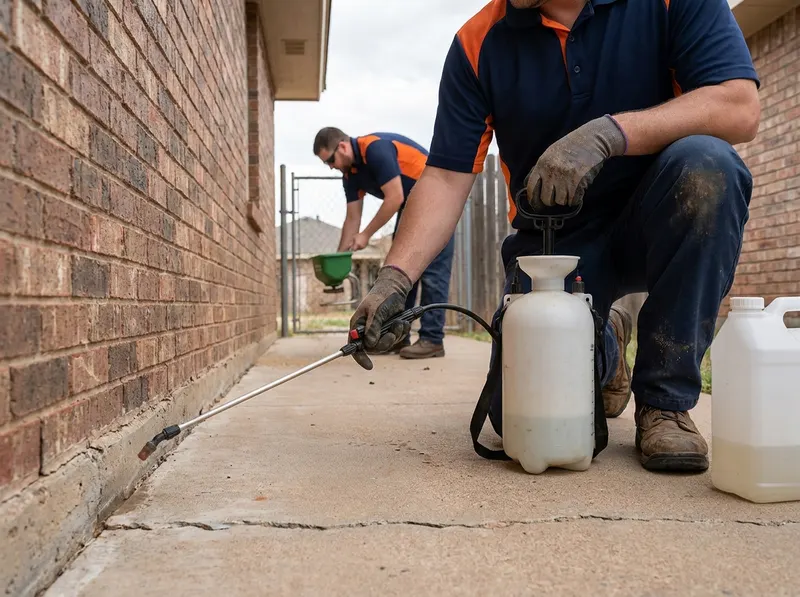
3. Exterior barrier application: Pressurized non-repellent liquid agents are applied around the structural base, door thresholds, and window frames to establish an invisible transfer zone.
4. Interior void placement: Precision crack-and-crevice gel or micro-dust applications are secured inside drywall penetrations out of reach of children and household pets.
5. Follow-up stabilization: Exterior perimeter monitoring confirms colony elimination, typically requiring 10 to 21 days for complete brood termination depending on nest size.
Every job gets a firm, written price after a free on-site visit.
Tell us about your ant eradication job in Lubbock and we'll send a clear, written quote, usually the same day.
 Torvexa Pest Management