Flea and tick populations across the South Plains expand rapidly between late spring and early autumn, driven by Lubbock's semi-arid heat and localized irrigation cycles. A targeted dual-action application fits…
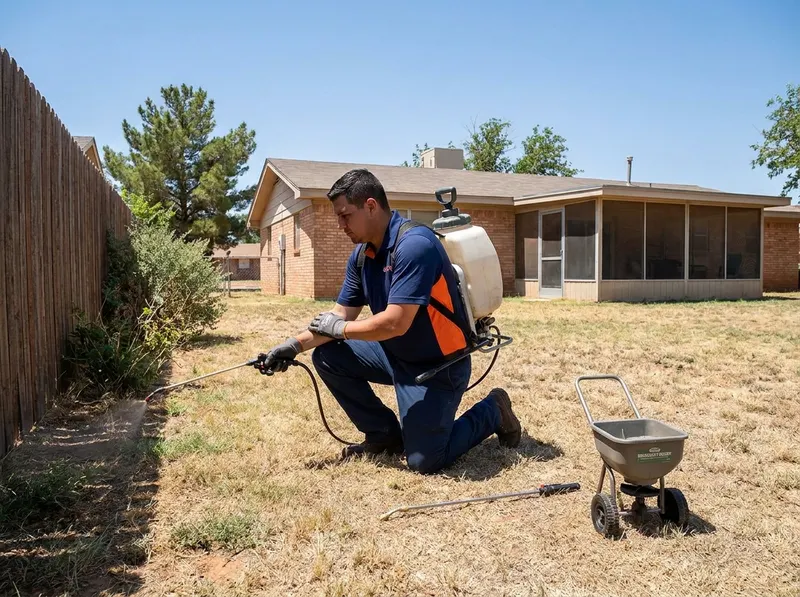
Flea and tick populations across the South Plains expand rapidly between late spring and early autumn, driven by Lubbock's semi-arid heat and localized irrigation cycles. A targeted dual-action application fits properties facing active parasitic activity where over-the-counter pyrethroid sprays fail to reach pupae concealed under thick turf or porch framing. Over-the-counter aerosol foggers disperse surface residues that do not penetrate shaded soil beds, leaving viable pupae protected inside protective cocoons. Professional management combines an adulticide to eliminate active biting adults with an insect growth regulator (IGR) that prevents juvenile larvae from reaching reproductive maturity, breaking the 21-day life cycle directly at the soil interface.
In mature neighborhoods such as Tech Terrace, Melonie Park, and Rush, deep tree canopies and established mulch beds create shaded, humid microclimates that shield flea larvae from West Texas heat. Ticks, particularly the brown dog tick, thrive along structural cracks, stone retaining walls, and brickwork common in Vintage Township and Lakeridge. Treatment parameters differ between low-water xeriscaping and dense Bermuda grass lawns near Maxey Park and Shadow Hills. Properties bordering alleyways and unimproved caliche corridors in North Overton and Bayless Atkins often experience re-infestation pressure from urban wildlife, requiring strict 3-foot vertical stem-wall foundation barriers and continuous yard-boundary bands.
Interior treatments serve as an essential secondary defense when pets bring active parasites inside structural boundaries. Technicians apply non-staining microencapsulated residuals along baseboards, beneath furniture frames, and across carpet perimeters, requiring residents and animals to vacate the interior for 2 to 4 hours until liquid deposits dry completely. The primary trade-off between exterior-only and full-structure treatments involves preparation labor: comprehensive interior eradication requires vacuuming all textile surfaces, laundering pet bedding in hot water exceeding 130 degrees Fahrenheit, and clearing floor spaces prior to technician arrival. Standalone perimeter treatments manage outdoor migrations effectively, whereas established home infestations demand simultaneous dual-zone execution.
Every job gets a firm, written price after a free on-site visit.
Tell us about your flea & tick management job in Lubbock and we'll send a clear, written quote, usually the same day.
 Torvexa Pest Management