Nuisance wildlife challenges in Lubbock County stem directly from regional environmental factors and urban layout. Semi-arid plains conditions push wild mammals toward irrigation sources, mature shade canopies, and the…
Nuisance wildlife challenges in Lubbock County stem directly from regional environmental factors and urban layout. Semi-arid plains conditions push wild mammals toward irrigation sources, mature shade canopies, and the crawlspaces of older single-family properties. Historic neighborhoods with established pecan and oak trees, such as Tech Terrace and Melonie Park, consistently experience roofline intrusions by fox squirrels and raccoons. Properties built over pier-and-beam foundations around Maxey Park, North Overton, and Bayless Atkins regularly encounter striped skunks and Virginia opossums burrowing beneath stem walls to escape winter freezes or intense summer heat. Newer constructions in Vintage Township and Lakeridge frequently show attic entries through open soffit gaps and builder vent returns along clay-tile or composite rooflines.
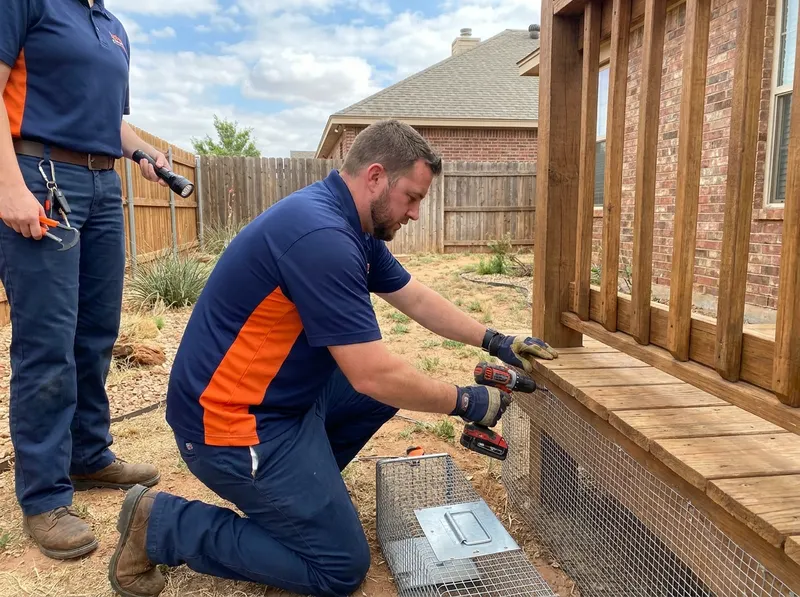
Effective structural defense distinguishes between simple animal capture and permanent physical exclusion. Live cage trapping removes the immediate intruder, but leaving entry gaps unresolved invites secondary colonizers within days. Permanent remediation relies on non-corrosive 1/4-inch or 1/2-inch galvanized steel hardware cloth, metal flashing, and structural sealants to close gable louvers, crawlspace grates, and roof returns. In situations involving bats or active maternal dens, technicians install one-way exclusion valves that permit animals to exit during evening feeding flights while physically barring re-entry. Trapping without exclusion creates an ongoing cycle of re-infestation; exclusion without trapping risks entombing animals inside wall voids and attic insulation, resulting in severe biohazard and odor issues.
1. Initial structural diagnostics: Technicians execute an exterior-to-interior survey, inspecting foundation perimeters, chimney caps, soffit transitions, and attic spaces for gnaw marks, rub lines, and biological waste.
2. Trapping and humane containment: Scent-baited humane traps are anchored along active run lines outside structural entryways and checked every 24 hours in accordance with Texas wildlife regulations.
3. Complete exterior exclusion: Technicians seal all auxiliary vents, fascia gaps, pipe penetrations, and crawlspace entries with heavy-gauge galvanized steel mesh.
4. Decontamination and scent neutralization: Technicians remove soiled insulation, extract droppings, and apply an enzymatic, anti-microbial fog to neutralize pheromones that attract wandering wildlife.
Every job gets a firm, written price after a free on-site visit.
Tell us about your nuisance wildlife trapping & exclusion job in Lubbock and we'll send a clear, written quote, usually the same day.
 Torvexa Pest Management