Lubbock's arid High Plains climate produces sustained heat from May through October, driving stinging insects to build protected colonies along exterior architectural shelter. In established areas like Tech Terrace and…
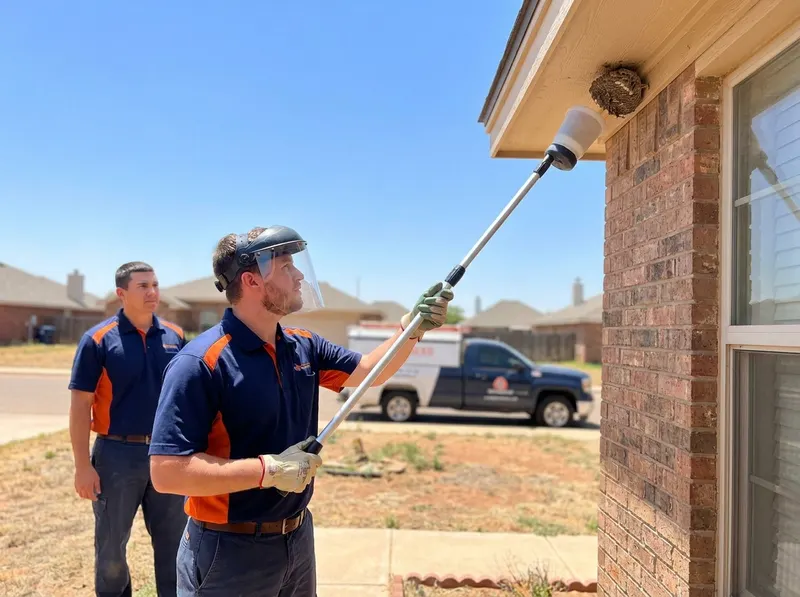
Lubbock's arid High Plains climate produces sustained heat from May through October, driving stinging insects to build protected colonies along exterior architectural shelter. In established areas like Tech Terrace and North Overton, older wood-frame soffits, unsealed fascia boards, and deep porch ceilings offer primary harborage for Polistes metricus and red paper wasps. Newer developments such as Vintage Township and Lakeridge frequently contend with aggressive western yellowjackets colonizing weep holes in brick veneers or building subterranean nests in irrigated landscape berms. Uncalibrated retail aerosol sprays frequently scatter guard wasps rather than penetrating the core brood combs, triggering aggressive swarm defense against family members and domestic pets.
Structural defense requires isolating the nesting matrix without contaminating residential breathing air. If an active colony occupies an open eave or window casement, a direct residual contact formulation and rapid mechanical takedown resolve the hazard cleanly. If workers enter weep screeds or attic ventilation louvers near Maxey Park or Melonie Park, topical spraying fails because the brood chamber sits several feet inside the wall cavity; these configurations require targeted micro-injection dusts that workers track directly into the queen's chamber. This method prevents secondary pest pressures, as untreated wasp larvae abandoned inside wall framing decompose and draw secondary carpet beetles, dermestids, and Turkestan roaches into the home.
Professional intervention protects the property boundary through four sequential actions: 1. Technicians visually inspect the roofline, chimney caps, perimeter shrubbery, and outbuildings to locate all satellite nests. 2. A non-repellent or fast-knockdown agent neutralizes the adult flight population to halt pheromone alarm signaling. 3. Physical scraping and removal of the embryonic matrix prevents brood emergence. 4. Spot application of a hydrophobic micro-encapsulated pyrethroid prevents neighboring fertilizing queens from re-anchoring to the same eaves. All products dry clear and bond to porous masonry, remaining stable under the intense West Texas UV index without producing volatile indoor vapors.
Every job gets a firm, written price after a free on-site visit.
Tell us about your wasp & stinging insect removal job in Lubbock and we'll send a clear, written quote, usually the same day.
 Torvexa Pest Management