Subterranean termite treatment requires continuous chemical or mechanical barriers because subterranean species nest in subterranean moisture pockets and access structural wood through mud tubes. In Lubbock County, the…
Subterranean termite treatment requires continuous chemical or mechanical barriers because subterranean species nest in subterranean moisture pockets and access structural wood through mud tubes. In Lubbock County, the semi-arid climate and caliche-rich clay soils cause foundation settling, creating micro-fissures in concrete slabs. Older pier-and-beam properties in Tech Terrace, North Overton, and Bayless Atkins allow direct ground-to-sill contact, whereas slab-on-grade builds in Vintage Township and Lakeridge force colonies up expansion joints and plumbing penetrations. Applying standard consumer retail sprays to interior baseboards only diverts workers to adjacent wall cavities without terminating the central nest located several feet below grade.
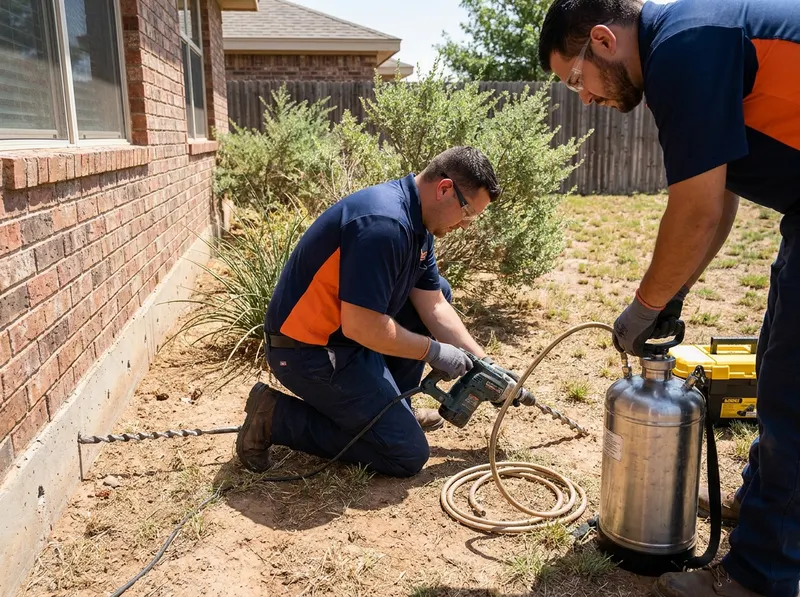
Treatment selection depends on structural architecture and soil profile. A non-repellent liquid barrier creates an undetectable lethal zone around the perimeter footer. Technicians dig a 6-inch by 6-inch trench along exposed foundation lines in neighborhoods like Rush and Melonie Park, saturating the backfill with termiticide at label-specified volumes, such as four gallons per ten linear feet. Where flatwork abuts the structure, such as concrete patios, driveways, or garage aprons in Shadow Hills and Maxey Park, 0.5-inch holes are drilled roughly twelve inches apart through the slab to reach the underlying soil. For properties bordered by dense decorative hardscaping, zero-clearance property lines, or high water tables, an in-ground bait station network provides structural defense with lower disruption, using insect growth regulators that foraging workers transfer back to eliminate the queen.
Liquid soil barriers offer immediate perimeter isolation and last 5 to 10 years, though they require invasive drilling of finished porches and perimeter walkways. In contrast, bait station networks avoid concrete drilling entirely and monitor colony activity continuously, but they require periodic inspection visits and take several months to achieve full colony suppression. Properties do not require mandatory long-term service contracts; treatments target the specific biology of West Texas subterranean termites without recurring subscription obligations. A complete perimeter installation typically takes one full workday, and technicians confirm exact linear footage and soil access requirements during the on-site assessment.
Every job gets a firm, written price after a free on-site visit.
Tell us about your subterranean termite treatment job in Lubbock and we'll send a clear, written quote, usually the same day.
 Torvexa Pest Management